
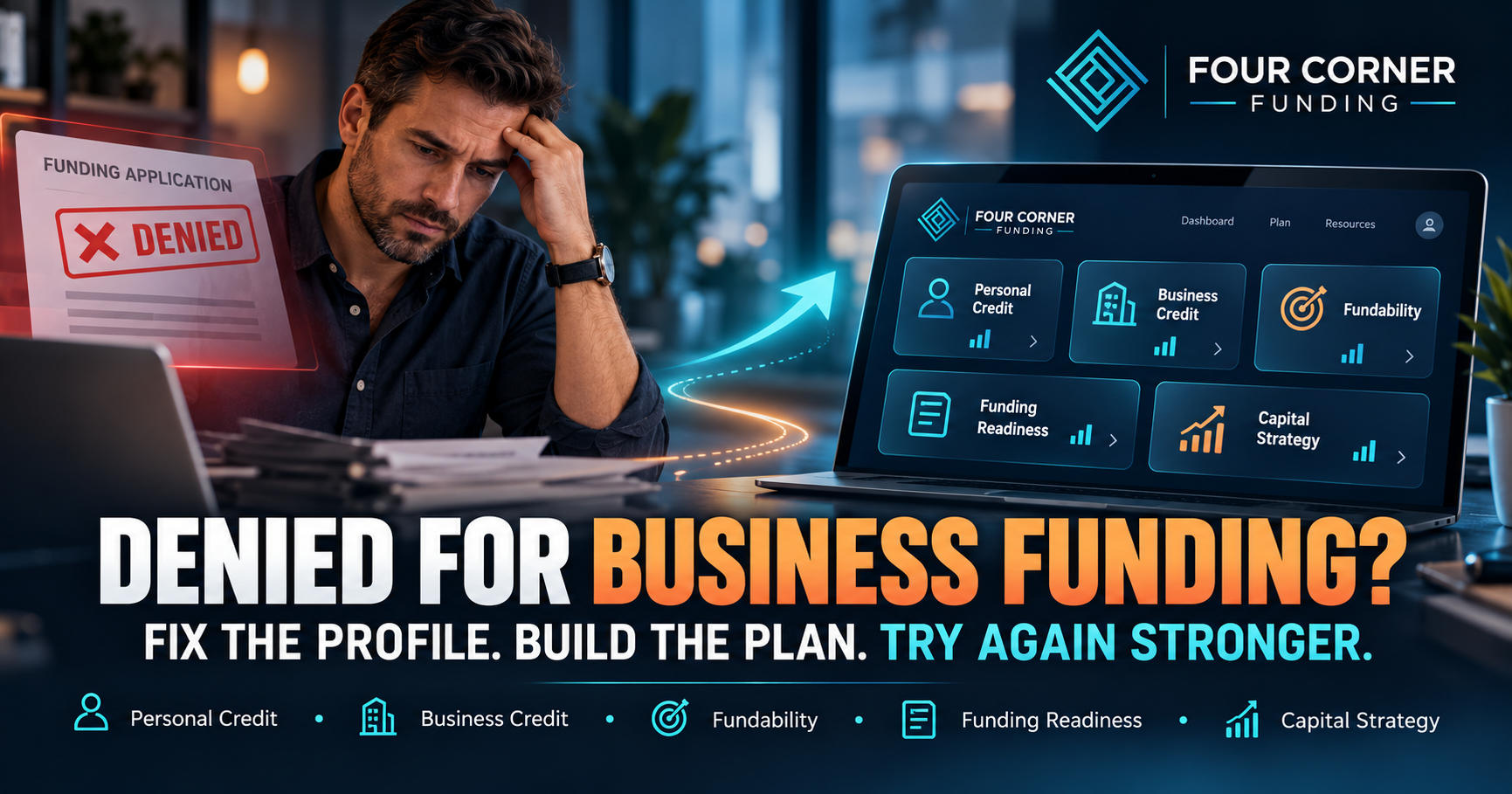
You applied for business funding and received a decline. Or perhaps you received an offer that was much smaller than the amount you needed. Before submitting another application, pause and ask: What is weakening the request—and what can potentially be improved?
A decline does not necessarily mean your business will never qualify for financing. It may mean your current profile, requested amount or transaction does not meet the requirements of that particular funding source or product. Different funding sources evaluate businesses differently.
The next step should be informed by the reason for the decline. Review any explanation you received, ask what factors affected the decision and examine the information submitted. Some issues can be corrected. Others may require stronger financial performance, more operating history or a different capital strategy.
A stronger application starts before you apply.
Review personal credit, business credit, fundability, financial activity, existing obligations, documentation and product fit together. Improving one area may help, but no single change guarantees approval.
Have a defined funding need? Apply for Funding. Want to understand where you stand first? Get Pre-Qualified. No credit check is required to begin either starting point; later stages may involve credit review and additional requirements.
1. Review your personal credit profile
Personal credit can matter for many forms of business financing, particularly when a personal guarantee is involved. A funding source may evaluate more than the score, including payment history, credit-card utilization, collections, recent inquiries and the overall condition of the credit profile.
Review your reports for accuracy, identify past-due obligations and understand how outstanding balances affect your profile. Dispute inaccurate information through the appropriate channels. Avoid assuming that opening more accounts or submitting more applications will resolve the underlying issue.
What to review: Accurate reporting, payment history, outstanding balances and recent application activity. There is no universal credit-score requirement across all commercial financing products.
2. Evaluate your business-credit profile
Forming a business does not automatically establish a business-credit history. Your company may have limited reporting accounts, a thin profile or business information that does not match across reporting sources.
Business credit development involves accurate company records, appropriate accounts, payment history and monitoring. Before opening an account to build business credit, confirm whether it reports to a relevant business-credit bureau and whether the account serves a useful business purpose.
The objective is a reliable business-credit profile. An established profile may be relevant to certain financing opportunities, but it does not replace revenue, repayment capacity, documentation or other requirements.
3. Fix gaps in business fundability
Fundability is broader than a credit score. It includes the business identity, financial condition and supporting information a funding source may evaluate when reviewing a request.
Check whether the information submitted accurately reflects your business:
- Legal business name, entity structure and registration status.
- Business address, phone number and contact information.
- Website and email information, where relevant.
- Industry classification and actual operating history.
- Required licenses and registrations.
- Consistency across banking, applications, company records and credit reporting.
Inconsistent information can create verification questions and delays. Correct genuine discrepancies rather than changing information to make the business appear eligible. A consistent identity supports a clearer review; it does not overcome insufficient repayment capacity or other underwriting concerns.
4. Examine business banking and cash flow
A business can generate sales and still struggle to support additional payments. Depending on the financing product, a funding source may evaluate revenue, deposits, average balances, overdrafts, insufficient-funds activity, cash-flow consistency and existing obligations.
Review what remains after normal operating expenses and debt payments. Identify seasonal changes, irregular collections and recurring pressure on the account. Distinguish business revenue from transfers or other deposits that do not represent sales.
The practical question: Can the business support the proposed repayment structure while continuing to operate? The answer should guide the amount, timing and type of financing pursued.
5. Account for existing debt and obligations
Existing loans, advances, credit-card balances, liens and other repayment obligations can affect additional financing capacity. The payment frequency and combined cash-flow impact matter alongside the outstanding balances.
Prepare an accurate debt schedule showing each obligation, current balance, payment amount, payment frequency and any relevant collateral or lien. Include obligations that may not appear on a credit report.
Do not assume another financing agreement will solve a cash-flow problem. Any proposed refinancing or additional borrowing should be evaluated for total cost, repayment burden and restrictions in existing agreements.
6. Prepare complete, consistent documentation
Missing pages, outdated financial information or conflicting figures can delay a funding review. Organizing the appropriate documents helps a funding source understand the business and the transaction.
Depending on the product and funding source, requested documents may include:
- Business bank statements and formation documents.
- Ownership information and identification.
- Tax returns and financial statements, when required.
- A current debt schedule.
- Equipment details, invoices, property information or acquisition documents for the relevant transaction.
Every transaction does not require every document. Confirm the applicable requirements, provide complete records and explain material differences between application figures and supporting documents. Submit sensitive information only through the designated secure process.
7. Match the capital strategy to the business
Sometimes the problem is product fit. The requested financing may not align with the business's revenue, operating history, credit profile, collateral, funding purpose or requested amount.
Equipment financing addresses a different need from a working-capital request. Receivables financing depends on eligible receivables and related factors. An acquisition or commercial real estate transaction involves different considerations from everyday operating capital.
Commercial financing categories that may be appropriate to explore include working capital, business lines of credit, term financing, revenue-based financing, equipment financing, receivables financing, SBA financing, acquisition financing, commercial real estate financing and construction financing.
Business credit-card strategies may also be relevant in appropriate circumstances. Introductory terms, repayment plans, fees, personal guarantees and the rate after a promotional period all deserve careful review. Product availability and eligibility vary.
More applications are not always the answer.
Repeatedly applying without addressing the reason for a decline can waste time and create unnecessary application activity. A more informed approach starts with understanding the business's current position.
Assess → Identify weaknesses → Improve readiness → Determine the capital strategy → Pursue funding
The goal should not be to submit more applications. The goal should be to become a stronger applicant.
How Four Corner Funding supports the next step
Four Corner Funding's approach considers both the immediate funding need and the business's readiness to pursue capital. Pre-qualification and a funding application provide starting points for understanding the request and determining what additional information or review may be needed.
When a business appears positioned to pursue financing, the next step may involve exploring appropriate opportunities through independent third-party funding sources. When gaps remain, the next step may involve reviewing personal credit readiness, business-credit development, fundability, financial information, documentation or the proposed capital strategy.
An assessment can help organize the questions and potential next steps. It does not replace a funding source's underwriting, establish eligibility for every product or guarantee an offer.
Two ways to start
Have a defined funding need?
Begin with the funding application and describe your business, the amount requested and the purpose of the funds.
Want to understand where you stand?
Begin with pre-qualification to provide initial information about your business and funding goals.
No credit check is required to begin either starting point. This does not mean that later underwriting will exclude credit inquiries, verification or requests for supporting documents.
Explore funding if you're ready. Build a path forward if you're not.
A decline is a reason to reassess the request. Understand the weaknesses, prepare the information and pursue capital with a clearer strategy.
Learn more at FourCornerFunding.com.
Important disclosure: This article provides general educational information. Four Corner Funding is the public brand of Four Corner Holdings, LLC and is not the lender or the final credit decision-maker. Independent third-party funding sources originate and/or underwrite financing and make final credit decisions. Financing is subject to underwriting, verification and applicable funding-source guidelines. Approval, funding amounts, rates, terms and timing are not guaranteed. Product availability, eligibility and documentation requirements vary by funding source, financing product and transaction. Pre-qualification, funding-readiness assessments and platform-generated outputs are preliminary and do not constitute final credit decisions, commitments to lend or guarantees of funding. Improvements to credit or business readiness do not guarantee approval.