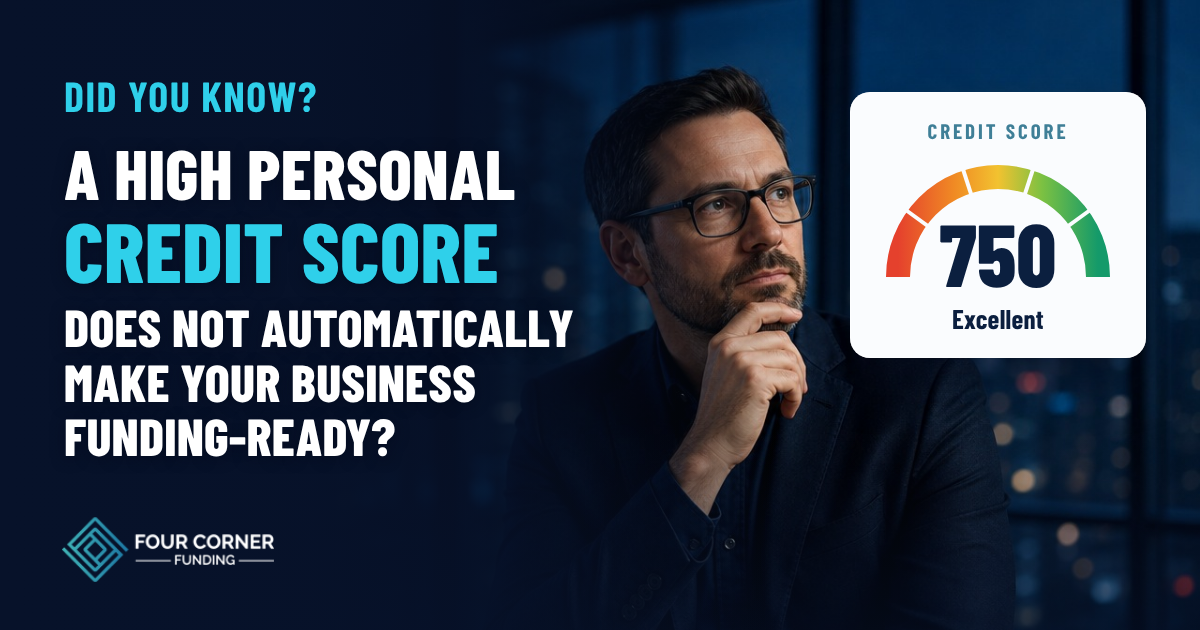
Many business owners treat a strong personal credit score like a pass. The thinking is simple: my score is excellent, I pay everything on time, so business funding should be a formality.
Then the request goes in, and the answer is a decline, a smaller amount than expected, or an offer that does not fit what the business actually needs.
The score was not the problem. The assumption was. A personal credit score is one input in a business-financing decision. It was never designed to describe a business.
Why the Assumption Feels Right
Most people learn how credit works through consumer borrowing: a credit card, a car loan, a mortgage. In those settings the personal credit score carries a lot of weight, and a strong one usually makes the process easier.
So it is natural to expect the same rule to apply when the business needs capital. But a commercial request adds a second subject to the file. The funding source is no longer evaluating only a person. It is evaluating a company: how it earns, what it owes, how long it has operated, and what it plans to do with the money.
That shift, from evaluating a person to evaluating a person and a business, is where a strong score stops being the whole answer.
What a Personal Credit Score Actually Measures
A personal credit score summarizes how one individual has handled personal credit: payment history, how much revolving credit is in use, how long accounts have been open, recent inquiries, and any collections or derogatory items.
That is useful information. But look at what it leaves out. A personal credit score does not show:
- How much revenue the business generates
- How consistently money moves through the business bank account
- What the business already owes
- How long the company has been operating
- Whether the business has a commercial credit profile of its own
- What the capital is for
A personal score answers one question: how has this person handled personal credit? A business funding request asks a different one: can this business support this obligation? A funding source usually needs an answer to both.
Personal Credit Still Matters
None of this makes personal credit unimportant. Depending on the financing product, many funding sources review the owner's personal credit, and some transactions involve a personal guarantee. A strong profile can widen the range of options a business is able to explore.
Even then, the number is rarely the whole picture. Two owners with similar scores can have very different profiles underneath: different balances, different recent activity, different depth of history. Different financing products weigh those details differently.
The takeaway
A strong credit score can open doors, but it does not tell the entire story of a business.
What Else a Funding Source May Evaluate
Underwriting criteria differ by funding source and by financing product, and not every funding source weighs every factor the same way. These are the areas that commonly sit alongside personal credit.
Revenue and banking activity
How much the business brings in, and how deposits, balances, and cash flow look in the business bank account over time.
Time in business
Operating history gives a funding source more to evaluate. Newer and established companies often have different options to consider.
Business credit
The company's own commercial credit profile, which is separate from the owner's personal credit and develops over time.
Existing obligations
Loans, lines of credit, advances, equipment payments, and card balances the business already carries, and how much room they leave for another payment.
Documentation
Whether the business can produce what the transaction calls for, such as bank statements, financial statements, tax returns, or formation documents, depending on the financing product and funding source.
Industry
Funding sources may treat industries differently, and some focus on or limit certain types of businesses.
Funding purpose and product fit
What the capital is for, how much is requested, and whether the financing product matches the job the money needs to do.
Same Score, Two Different Businesses
Consider two owners with the same 750 personal credit score.
Business A
- Has operated for several years
- Shows consistent deposits in a dedicated business bank account
- Keeps organized financial records
- Carries modest existing debt
- Needs capital for a specific equipment purchase, with a vendor quote in hand
Business B
- Was formed a few months ago
- Has a limited revenue history
- Runs business and personal money through the same account
- Already carries several payment obligations
- Wants as much capital as possible, with no defined use
The personal credit looks identical. The funding requests do not.
Neither outcome is guaranteed, and the final decision always belongs to the funding source. But Business A gives an underwriter far more to work with. Business B is not out of options. It may simply have preparation to do before its request reflects the strength of its owner's credit.
Your credit score describes you. A funding request has to describe the business.
Strong Score, Unsure About the Business? Start Here
If your personal credit is strong and you are not certain the business is equally prepared, these steps help close the gap between the two.
- Look at the full profile, not only the score. Strong credit is an asset. Treat it as a starting point rather than the conclusion.
- Read your business bank statements the way an outsider would. Are deposits consistent? Does business activity run through a business account?
- List what the business already owes. Know your current payment obligations before adding another one.
- Get documentation in order. What is required depends on the financing product and funding source, but organized records make any request easier to evaluate.
- Define the use of funds. A specific purpose helps point toward the right financing category.
- Find out where the business credit profile stands. Forming an entity and obtaining an EIN does not automatically create one.
Already received a decline? Our earlier article, Denied for Business Funding? 7 Things to Fix Before You Apply Again, covers what to address before the next application.
Where Four Corner Funding Fits
Four Corner Funding is built for both sides of this question: funding if you're ready, and a path forward if you're not.
Pre-Qualification is a readiness and planning tool. It helps you see where the business currently stands, what may be affecting its funding readiness, and what to consider doing next. It is not an approval or a final underwriting decision.
If the business already has a defined capital need, the funding application begins the funding-request process, where eligible businesses can explore financing through independent third-party funding sources.
A high personal credit score is worth protecting. Just do not ask it to answer a question it was never built to answer.
See Where Your Business Actually Stands
Start with Pre-Qualification to understand your funding readiness, or apply if you have a defined funding need. No credit check is required to begin either starting point.
Funding if you're ready. A path forward if you're not.
Important disclosure: This article provides general educational information and is not legal, tax, or financial advice. Four Corner Funding is the public brand of Four Corner Holdings, LLC and is not the lender or the final credit decision-maker. Independent third-party funding sources originate and/or underwrite financing and make final credit decisions. Financing is subject to underwriting, and approval is not guaranteed. Product availability, eligibility, and documentation requirements vary by funding source, financing product, and transaction. Pre-Qualification and funding-readiness information are preliminary and are not final credit decisions or commitments to lend. No credit check is required to begin Pre-Qualification or the funding application; later stages may involve credit review and additional requirements. The examples in this article are illustrative only and do not represent the requirements of any funding source.