Business credit cards tend to get one of two reactions from owners. Some treat them as easy money. Others avoid them entirely. Neither approach gets the most out of the tool.
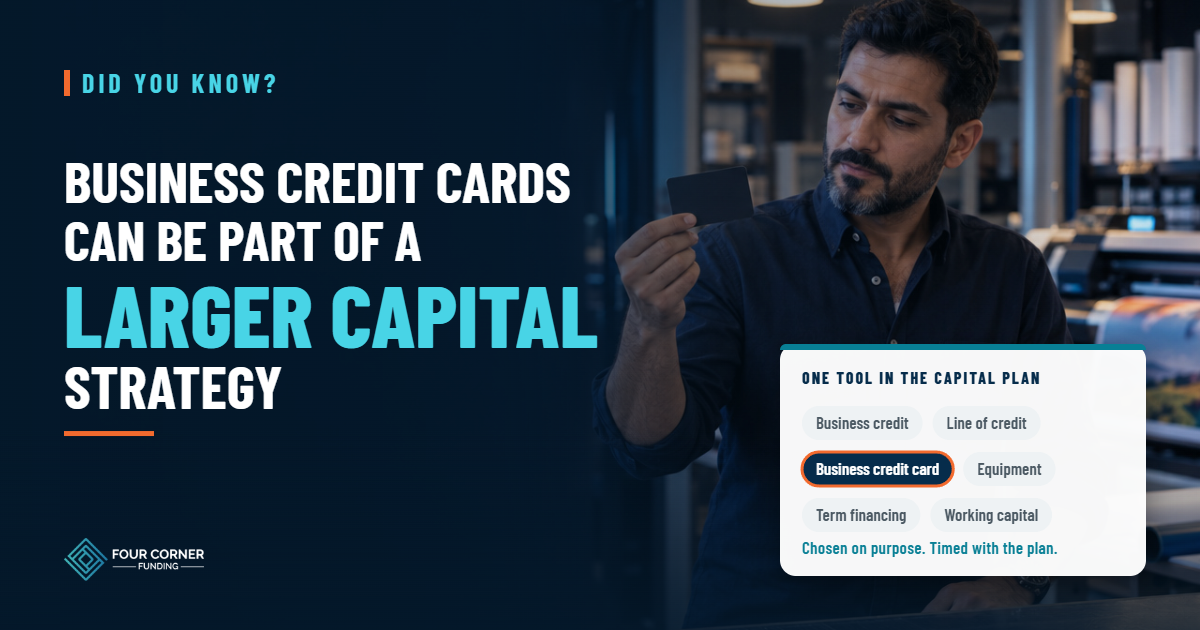
Did you know business credit cards can be part of a larger capital strategy? Used deliberately, a card can handle everyday expenses, keep business spending separate, and provide flexible revolving capacity. Used randomly, cards can add balances, inquiries, and personal exposure that complicate the next funding request.
The difference is not the card. It is the plan around it.
What a Business Credit Card Is Built to Do
A card is revolving credit: you draw on it, repay it, and draw again. That makes it well suited to some jobs and poorly suited to others.
A business credit card is a financial tool, not a complete capital strategy by itself.
Five Things to Understand Before You Apply
Personal guarantees. Many business cards require the owner’s personal guarantee, and issuers commonly review the owner’s personal credit when making a decision. A business card is often still connected to the person who applies for it.
How the account reports. Reporting practices vary by issuer and product. Some business cards report activity to commercial credit bureaus, and some may report to personal bureaus in certain situations. Read the terms before you rely on a card to build anything.
Issuer criteria. Each issuer sets its own approval criteria, limits, and terms. These can involve credit, income or revenue, existing relationships, and recent application activity, and they change over time.
Introductory offers. Where they are offered, promotional rates are temporary. Plan for the balance at the end of the promotional period, not just at the start.
Utilization. High balances can affect how a credit profile appears, on personal reports, business reports, or both, depending on how the card reports. We covered this in how credit card utilization can affect more than your credit score.
Why Random Applications Work Against You
Applying for several cards in quick succession with no plan can mean multiple inquiries and new accounts in a short window. Issuers and other funding sources may see that activity, and the balances that follow, when they review the next request.
That makes a scattered approach costly twice: it can make the next card harder to obtain, and it can complicate a larger financing request that matters more. It is the same lesson we covered in why more funding applications are not always the answer, applied to cards.
A Card Is Not the Same as a Line of Credit
Both are revolving, so owners often treat them as interchangeable. They are not always the same tool. A business line of credit is typically drawn as cash for operating needs and may be underwritten more heavily on the business’s revenue and banking. A card is built around purchases and is often tied more closely to the owner’s credit, as noted above. Terms, limits, and costs differ by product and provider.
For a business with regular purchasing needs, a card may handle the spending while a line, where available, covers cash timing gaps. Knowing which tool does which job keeps either one from being stretched into something it was not designed for.
Order and Timing Matter
A card strategy considers which accounts to pursue, in what order, and how each decision may affect the next. That includes the applicant’s profile, the accounts already open, current credit exposure, timing, and the broader capital plan. If a larger financing request is coming in the next few months, for example, it is worth thinking about how new accounts and balances may look to that funding source before applying for anything else.
Where a card fits in a capital plan
Foundation — consistent business information, business banking, and clean records.
Profile — a clear view of both personal and business credit before any application.
Purpose — the specific expenses the card is meant to handle.
Sequence — which accounts, in what order, and at what point in the larger plan.
Management — balances repaid on schedule, utilization watched, and statements kept with the business records.
Capital sequencing gets its own article later in this series, because the order in which a business pursues financing can matter well beyond cards.
Using the Card Well Once You Have It
- Keep it for business expenses only, so the statements tell a clear business story.
- Know your repayment plan for each purchase before you make it.
- Watch balances relative to limits, especially before a larger financing request.
- Pay on time, every time. Payment history is one of the most visible parts of any credit profile.
- Review the terms periodically. Rates, offers, and reporting practices can change.
Where Four Corner Funding Fits
Business Credit Card Sequencing is part of Four Corner Funding’s Capital Access approach. The idea is to understand the applicant profile, existing accounts, credit exposure, timing, and broader capital goals before pursuing applications, so a card supports the plan instead of interrupting it.
It works alongside the Business Credit Builder and other financing options rather than replacing them. Approvals, limits, and offers are determined by card issuers and are never guaranteed. Pre-Qualification is a good place to start, and you can begin without a credit check.
Funding if you’re ready. A path forward if you’re not.
Put the Card Inside a Plan.
Understand where your profile stands before your next application, and how each step fits the bigger capital picture.
A business credit card can be a useful part of how a company manages money. It works best when it is chosen on purpose, used for the right jobs, and timed with everything else the business plans to do.
Disclaimer: This article is for general educational purposes only and is not credit, legal, tax, or financial advice. Four Corner Funding is not a lender or card issuer and does not make credit decisions. Card approvals, credit limits, rates, promotional offers, and reporting practices are determined by each issuer, vary, and may change. Financing is provided by independent third-party funding sources and is subject to their underwriting, eligibility requirements, product availability, and documentation requirements. Pre-Qualification and readiness results are not approvals or final credit decisions, and approval is not guaranteed.