
You pay every card on time. You have never missed a due date. Your credit score looks respectable. Then you apply for business financing and the response is weaker than you expected — a smaller offer, more questions, or a request to revisit later.
For many business owners, the explanation is not a missed payment. It is how much of their available revolving credit is already in use.
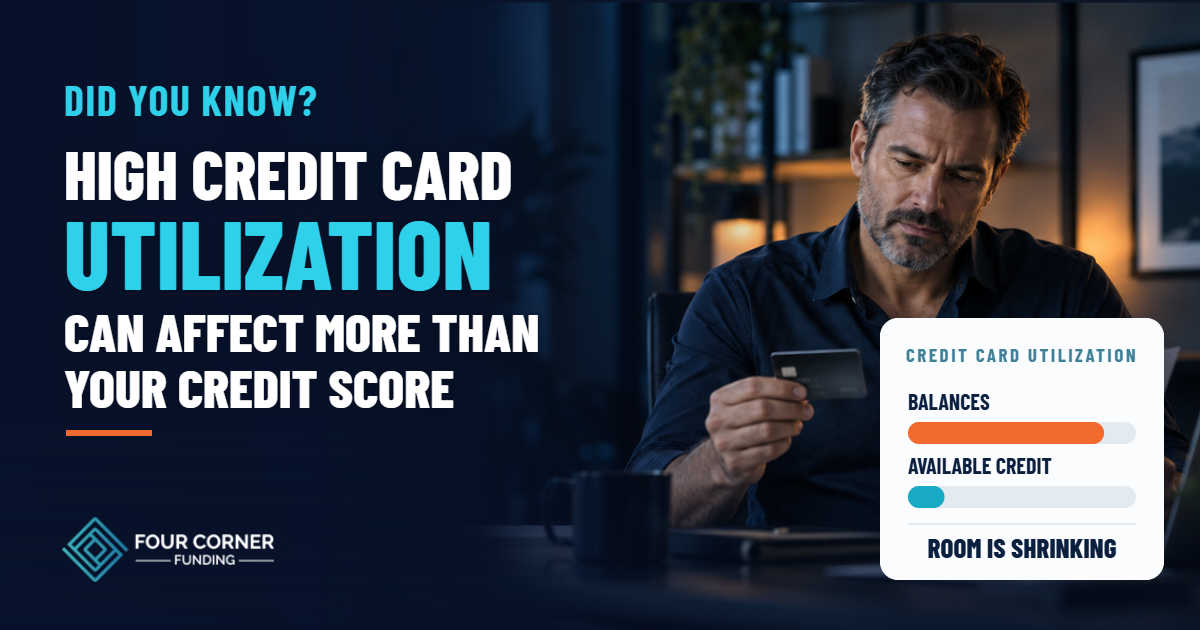
That measurement is called credit utilization, and most people think of it only as a score factor. Did you know it can also shape how a funding source reads your capacity, your cash flow, and how dependent the business may be on revolving debt?
What Credit Utilization Actually Measures
Credit utilization compares the balances on your revolving accounts — mainly credit cards and revolving lines — with the total credit limits on those accounts. It is usually expressed as a percentage.
Two views of utilization are commonly discussed: overall utilization across all revolving accounts, and per-account utilization on each individual card. A profile can look acceptable in total while one or two cards sit close to their limits.
A simple illustration
| Card A | $7,000 balance / $10,000 limit = 70% |
| Card B | $8,000 balance / $10,000 limit = 80% |
| Overall | $15,000 / $20,000 = 75% |
Figures are illustrative only. They show how the calculation works — they are not a benchmark, a target, or a lender requirement.
Utilization generally applies to revolving credit. Installment debt — a vehicle loan or a term loan with a fixed payment schedule — is evaluated differently, although it still counts as part of your overall obligations.
You will not find a universal “safe” percentage here. Scoring models and funding sources do not all treat utilization the same way, and a number that looks fine for one product can raise questions for another. What matters is understanding the direction your balances are moving and what they signal.
Why Utilization Reaches Beyond the Score
High utilization can pull a credit score down. That part is widely understood. What is less understood is that a funding source reviewing a file may read the same balances through several other lenses at the same time.
One balance, three readings
The score. Utilization is one of the factors many scoring models weigh, so heavy balances can lower the number itself.
The capacity. Limits that are mostly used leave little room for the unexpected — and the minimum payments on those balances already claim part of monthly cash flow.
The pattern. Balances that keep rising can suggest the business is relying on revolving credit to cover operations. Some funding sources pay close attention to that trend.
Credit availability can matter almost as much as credit usage.
This is also why paying on time does not settle the question. Payment history shows that obligations are being met. Utilization shows how much room is left after they are met. A funding source evaluating whether a business can take on another payment may care about both.
As covered earlier in this series, a strong personal credit score does not automatically make a business funding-ready. Utilization is one of the clearest examples of why: two owners with similar scores can show very different amounts of breathing room.
Personal Cards, Business Cards, and Where the Balance Shows Up
Many owners run business expenses through personal credit cards, especially in the early years. Those balances appear on the owner’s personal credit report. To a funding source reviewing personal credit, a personal card carrying inventory, payroll gaps, or equipment purchases looks the same as any other personal debt.
Business credit cards are not automatically separate either. Many are personally guaranteed, and depending on the issuer and the account’s status, some business card activity may be reported to personal credit bureaus. Owners are often surprised to find a business balance affecting their personal profile.
This is one reason building a distinct business-credit profile matters — a subject we explored in why forming an LLC does not automatically build business credit. Separation does not make personal credit irrelevant, but it can make the financial story of the business easier to read.
Worth checking before you apply
Which of your cards report to your personal credit file, which report to business credit bureaus, and which report to both? The answer can change which profile a funding source sees carrying the balance.
Why Closing Cards Is Not Automatically the Fix
When owners learn utilization matters, a common reaction is to close cards they no longer use. It feels like reducing risk. Mathematically, it can do the opposite.
Return to the illustration above and add a third card with a $10,000 limit and no balance. Overall utilization becomes $15,000 out of $30,000 — 50%. Close that unused card and the same $15,000 in balances is measured against $20,000 again — 75%. Nothing was charged, yet the profile looks more stretched.
None of these moves is always wrong. The point is that each one has consequences beyond the single number you are trying to change. Credit decisions work better as part of a plan than as quick reactions.
Timing Matters: The Reported Balance Is Often a Snapshot
Many card issuers report the balance shown on your statement, not the balance after you pay. That means an owner who charges heavily during the month and pays in full every time can still appear highly utilized on a credit report.
Reporting practices vary by issuer, but understanding when your statements close can help. Paying down a balance before the statement date — rather than only before the due date — may lower the balance that gets reported for that cycle.
This matters most in the weeks before you seek capital. The credit profile a funding source reviews reflects what was reported, not what you intended to show.
Practical Steps Before You Seek Capital
Utilization is one of the more controllable parts of a credit profile. It can change within a few billing cycles, which makes it worth reviewing well before a funding request rather than the week of one.
- Know both numbers. Calculate overall utilization and per-card utilization. Identify any card sitting close to its limit.
- Map where each card reports. Personal file, business file, or both. This tells you which profile is carrying which balance.
- Learn your statement dates. Time pay-downs around when balances are reported, not only when payments are due.
- Pause before closing accounts. Understand what closing a card does to available credit and account history before you decide.
- Avoid stacking new revolving debt immediately before a funding request unless it is part of a deliberate plan.
- Separate business spending where appropriate, so the business’s financial activity is easier to identify and evaluate.
- Review the whole profile, not just one ratio. Utilization interacts with payment history, revenue, banking, existing obligations, and the type of financing you need.
That last step is where many owners get stuck. Lowering utilization helps, but it does not by itself tell you whether the business is ready for a particular financing product — or which product fits the need.
Where Four Corner Funding Fits
Four Corner Funding’s Pre-Qualification is built to help business owners see where they currently stand before pursuing financing. It looks at funding readiness as a whole — personal credit, business credit, revenue, banking, existing obligations, and more — so utilization is evaluated in context rather than in isolation.
If the business may be ready, the next step can be exploring appropriate financing through independent third-party funding sources. If it is not yet ready, the goal shifts to identifying what to improve and in what order — including how card balances, new accounts, and future financing decisions affect one another.
You can begin either path without a credit check.
Funding if you’re ready. A path forward if you’re not.
Know What Your Credit Profile Is Saying Before a Funding Source Reads It
Find out how your current balances, credit, and business profile fit together — and what the right next step may be.
Utilization is rarely the only story in a credit file, but it is one of the easiest to misread. The balances you carry tell a funding source how much room you have left — and room is often what a lender is really trying to measure.
Disclaimer: This article is for general educational purposes only and is not credit, legal, tax, or financial advice. Four Corner Funding is not a lender and does not make credit decisions. Financing is provided by independent third-party funding sources and is subject to their underwriting, eligibility requirements, product availability, and documentation requirements, all of which vary. Credit scoring models and reporting practices vary by bureau and issuer. Pre-Qualification and readiness results are not loan approvals or final credit decisions, and approval is not guaranteed.