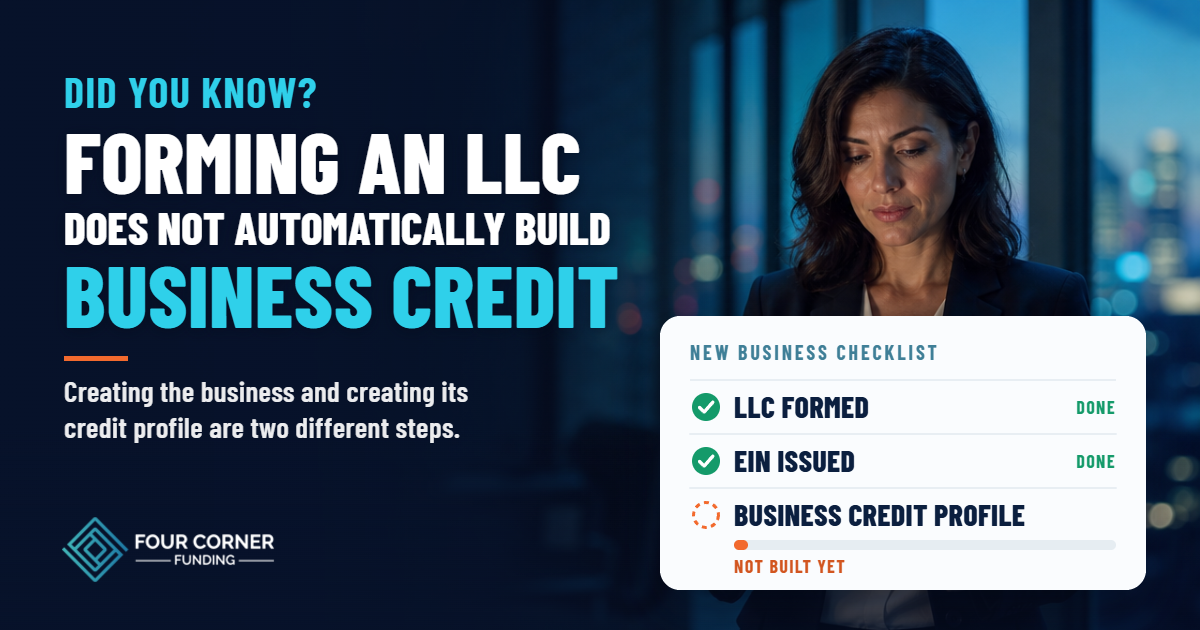
You filed the paperwork. The state approved your LLC. The IRS issued an EIN. On paper the business is real, so it is easy to assume it now has business credit too.
In most cases, it does not. Not yet.
Formation creates the company. It does not create a record of how that company handles credit. Those are separate steps, and the gap between them is why many new owners are caught off guard the first time the business is asked to stand on its own.
What Forming an LLC Actually Does
An LLC or corporation is a legal structure created through a state filing. It gives the business a legal name, a formation date, and a standing with the state.
That matters. A properly formed entity is part of the foundation that funding sources, credit issuers, and commercial credit bureaus may look at when they verify a business.
But a state filing records that the company exists. It does not record a single account, payment, or credit relationship. There is nothing in it for a credit bureau to score.
What an EIN Does, and What It Does Not Do
An Employer Identification Number is a federal tax ID issued by the IRS. Businesses commonly use it to file taxes, run payroll, and open a business bank account.
The EIN is often described as a Social Security number for the business, and that comparison is where the confusion starts. Because a Social Security number is tied to a personal credit file, many owners assume an EIN arrives with a business credit file attached.
It does not. An EIN identifies the business for tax purposes. It is not a credit file, and having one does not mean anyone has extended credit to the company.
An EIN also does not remove the owner from the picture. Depending on the financing product, a funding source or card issuer may still review the owner's personal credit or require a personal guarantee, whether or not the business has its own tax ID.
Two steps, not one
Creating the business and creating the business-credit profile are two different steps.
Where Business Credit Actually Comes From
Business credit is compiled by commercial credit bureaus such as Dun & Bradstreet, Experian Business, and Equifax Business. Each one maintains its own records and uses its own models, so the same company can look different from one bureau to the next.
These bureaus gather business information from several places, which may include public records and payment experiences reported by companies that extend credit to the business. A newly formed company may have a thin file, or no file at all, at one or more of them.
The part that takes real effort is payment data. A business-credit profile gains substance when creditors and suppliers report how the business pays, and reporting is voluntary. Not every vendor, supplier, or lender reports to the commercial bureaus, and those that do may not report to all of them.
An account that never reports adds nothing to the profile, no matter how well it is paid.
A verifiable business identity
A legal name, address, phone number, and other details that match across the records where the business appears.
Accounts that report
Credit relationships with companies that share payment activity with one or more commercial credit bureaus.
Payment history
A record of how the business pays those accounts, built one billing cycle at a time.
Depth and age
More than one reporting relationship, and enough time for the profile to show a pattern rather than a single data point.
Monitoring
Periodic review of what the bureaus show, so errors and gaps are found before a funding source finds them.
Formed Is Not the Same as Established
Put the two side by side and the difference is easy to see.
What formation gives the business
- A legal entity recognized by the state
- An EIN for tax and banking purposes
- The ability to open accounts in the business name
- A starting point for everything that follows
What business credit still needs
- Commercial credit bureau files with accurate business information
- Accounts that report payment activity
- A track record of on-time payments
- Time for the profile to gain depth
An LLC gives your business a legal identity. It does not give it a credit history.
Three Assumptions Worth Correcting
The LLC myth usually travels with a few others. Each one can lead a new owner to expect something business credit was never going to deliver on its own.
"Once I have business credit, my personal credit will not matter."
Business credit and personal credit are separate profiles, but many forms of business financing still consider the owner's personal credit, and some involve a personal guarantee. A stronger business profile adds to the picture. It does not make the personal profile irrelevant overnight. We covered the other side of this in why a high personal credit score does not automatically make a business funding-ready.
"Business credit can be built in a few weeks."
Payment history is recorded as it happens. There is no shortcut that produces months of on-time payments instantly, so be cautious of any promise of a specific score or timeline.
"A good business credit score means the business will be approved."
A score is one input. Depending on the financing product, a funding source may also evaluate revenue, banking activity, existing debt, time in business, and documentation. Underwriting criteria differ by funding source, and no score guarantees financing.
What to Do After You Form the Business
If the entity is formed and the credit profile is not, the work ahead is practical and mostly within your control.
- Confirm the foundation. Make sure the entity is active and in good standing with the state, and that the legal name, address, and EIN records agree with one another.
- Open a business bank account and use it. Run business income and expenses through the business account rather than a personal one.
- Make the business easy to verify. A business phone number, a professional email address, and a working website, where relevant, should match the rest of your records.
- Find out what the commercial credit bureaus show. Check whether files exist for the business and whether the information in them is accurate.
- Add reporting accounts at a pace the business can support. Before opening a vendor or credit account, ask whether it reports payment activity to the commercial bureaus. Take on only the credit the business has a real use for.
- Pay on time, every time. Payment history is the part of the profile you influence most directly.
- Review the profile and give it time. Business credit develops over months and years of consistent activity, not in a single filing.
Where Four Corner Funding Fits
Four Corner Funding is built for business owners on either side of readiness: funding if you're ready, and a path forward if you're not. For a newly formed business, the path forward often starts with the foundation.
Our Business Credit Builder is a structured, staged approach. It begins with a foundation and compliance stage, which focuses on getting the entity, records, and business identity in order, before moving on to building, aging, expanding, and evaluating the company's commercial credit profile. It is designed to support responsible development over time. It does not guarantee a specific score, credit limit, approval, or timeline.
If you are not sure where the business stands today, Pre-Qualification is a readiness and planning tool. It helps you see what may be affecting your funding readiness and what to consider doing next. It is not an approval or a final underwriting decision.
Filing the LLC was the right first step. It was not the last one.
Formed the Business? See What Comes Next
Pre-Qualification shows where your business stands today and what may need attention before you pursue capital. Already have a defined funding need? Start a funding application. No credit check is required to begin either starting point.
Funding if you're ready. A path forward if you're not.
Important disclosure: This article provides general educational information and is not legal, tax, or financial advice. Entity selection, formation, and tax matters should be reviewed with a qualified attorney or tax professional. Four Corner Funding is the public brand of Four Corner Holdings, LLC and is not the lender or the final credit decision-maker. Independent third-party funding sources originate and/or underwrite financing and make final credit decisions. Financing is subject to underwriting, and approval is not guaranteed. Product availability, eligibility, and documentation requirements vary by funding source, financing product, and transaction. Business-credit development takes time, and no specific score, credit limit, approval, or timeline is guaranteed. Commercial credit bureaus are independent companies that maintain their own records and scoring models; their names are used for identification only and do not imply affiliation or endorsement. Pre-Qualification and funding-readiness information are preliminary and are not final credit decisions or commitments to lend. No credit check is required to begin Pre-Qualification or the funding application; later stages may involve credit review and additional requirements.