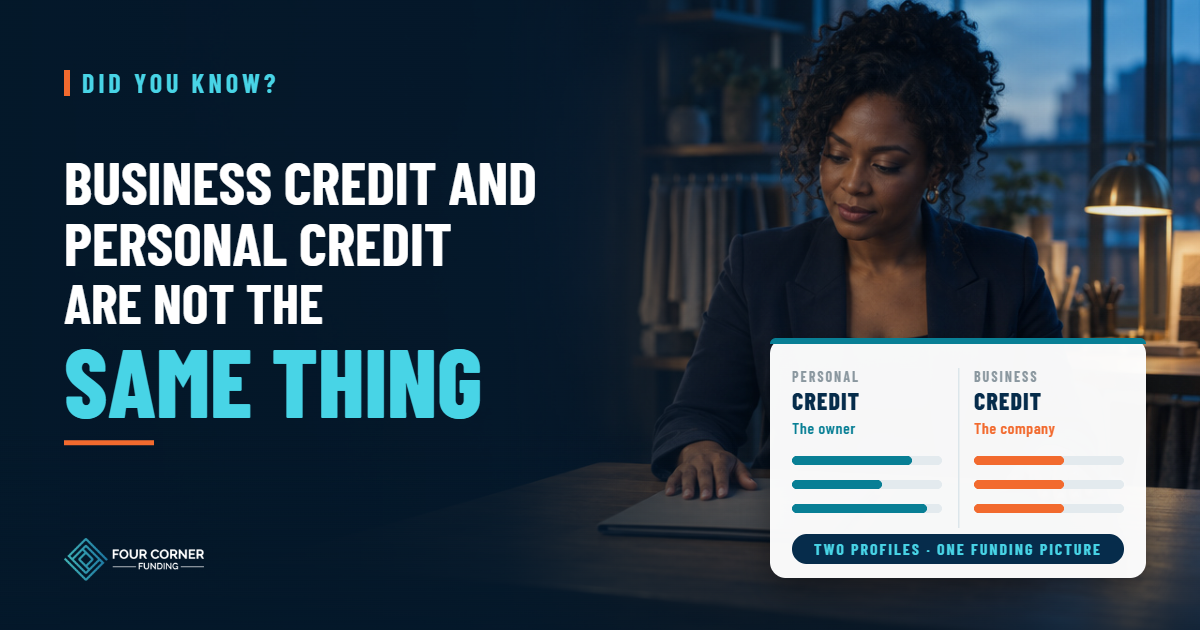
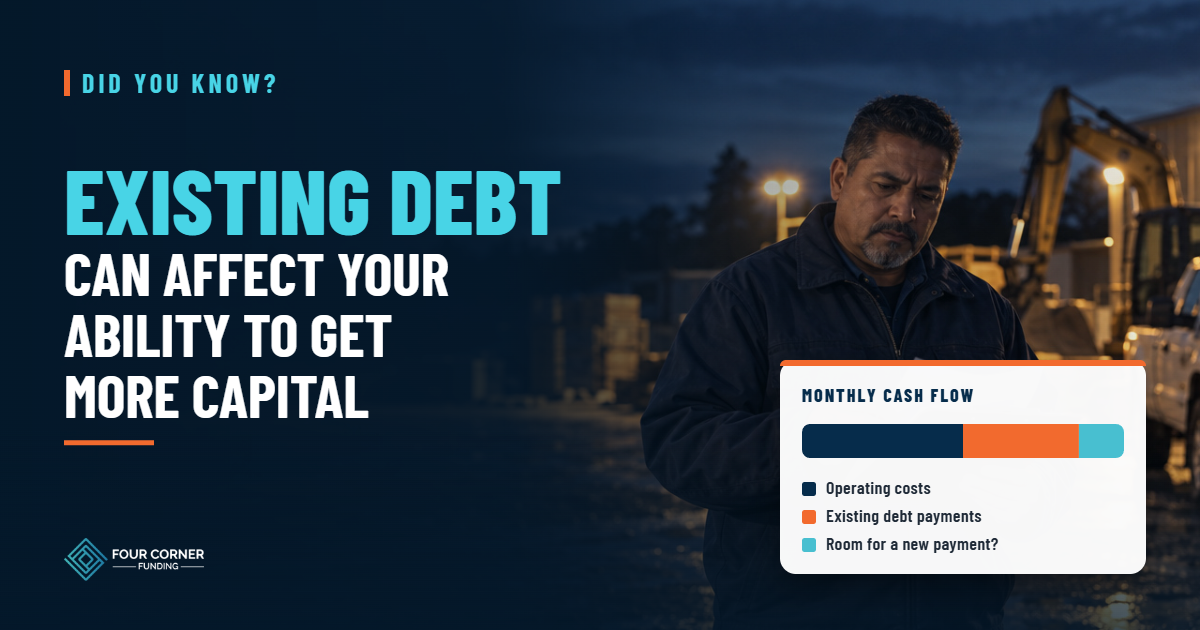
When a business needs capital, the conversation usually starts with what it wants next. A funding source will often start somewhere else: what the business already owes.
Did you know existing business debt can affect your ability to obtain more capital? Every loan, advance, line, lease, and card balance the business carries claims part of its future cash flow. When a new request comes in, a funding source will usually want to know how much room is left.
That does not make debt bad. Used well, financing helps businesses buy equipment, cover gaps, and grow. The point is simpler: today’s obligations become part of tomorrow’s application.
One Obligation, Four Places It Shows Up
Owners tend to think of a debt as a balance. In a funding file, a single obligation can appear in several places at once.
In cash flow
Every scheduled payment reduces the cash available to support a new one.
In the bank statements
Recurring withdrawals are visible to anyone reviewing the account, especially frequent daily or weekly debits.
In credit files
Balances, available credit, and payment history can appear on personal or business credit reports, depending on how the account reports.
In liens and collateral
Some financing involves a lien or UCC filing on business assets, which can affect what remains available to support a new request.
The bank statement view matters more than many owners expect. We explained why in what your bank statements can tell an underwriter.
Obligations a Funding Source May Ask About
Depending on the product, a funding source may want to understand any of the following. Not every review looks at every item.
The Real Question Is Capacity
For many products, underwriting comes down to a capacity question: after the business covers its operating costs and existing obligations, is there enough left to support another payment?
How that question gets answered depends on the product. Amortized and institutional financing commonly looks at annual cash flow relative to total debt payments. Revenue-based products may focus more on payment burden, how often payments leave the account, and how deposits move from week to week. Real-estate and asset-based transactions bring their own measures into the picture.
There is no single universal debt limit. Two businesses with the same total debt can look very different depending on revenue, cash flow, payment schedules, and what the debt was used for.
Existing capital can solve yesterday’s problem while affecting tomorrow’s borrowing capacity.
When Financing Starts to Stack
One pattern deserves its own warning. When a business takes on several short-term obligations close together, sometimes to cover the payments on earlier ones, the payments can pile up faster than revenue grows. Each new layer can make the next request harder, not easier, and many funding sources look closely for this pattern.
If that sounds familiar, the answer is rarely another application. As we wrote in why more funding applications are not always the answer, the work usually starts with the file itself.
Build Your Debt Schedule Before You Apply
Many owners cannot list every obligation from memory with its payment amount and frequency. A simple debt schedule fixes that, and some funding sources ask for one depending on the product.
For each obligation, record
✓ Who it is owed to and what type of financing it is
✓ The original amount and the current balance
✓ The payment amount and how often it is paid: daily, weekly, or monthly
✓ The maturity or expected payoff date
✓ Whether it is secured, and by what
✓ Whether it is current, and any past-due history
Then convert every payment to a monthly figure and add them up. Setting that total beside average monthly deposits and operating costs gives you an honest view of how much room remains, before a funding source draws its own conclusion.
What You May Be Able to Improve
- Let short-term obligations run their course where it makes sense, rather than adding new ones on top.
- Pay down revolving balances where cash flow allows, which can also improve available credit.
- Ask whether refinancing or consolidation is appropriate. Some structures exist for this purpose, and eligibility varies.
- Match future financing to its purpose, so short-term money is not carrying long-term needs.
- Protect your payment history on everything currently open.
Where Four Corner Funding Fits
Four Corner Funding’s Pre-Qualification reviews existing obligations alongside revenue, banking, credit, and the request, so you can see how current debt may be affecting your position before you apply.
If the business may be ready, the next step can be exploring options through independent third-party funding sources. If debt is the constraint, the plan may start with reducing the load before adding to it. You can begin without a credit check.
Funding if you’re ready. A path forward if you’re not.
Know What the Business Already Carries Before You Ask for More.
See how existing obligations fit into your funding profile and what your next step should be.
Debt is a tool. The businesses that use it best know exactly what they already owe, what it costs them each month, and how it will look to the next funding source that reads the file.
Disclaimer: This article is for general educational purposes only and is not credit, legal, tax, or financial advice. Four Corner Funding is not a lender and does not make credit decisions. Financing is provided by independent third-party funding sources and is subject to their underwriting, eligibility requirements, product availability, and documentation requirements, all of which vary. The examples above are general and are not lender criteria. Refinancing or consolidation may not be available or appropriate for every business. Pre-Qualification and readiness results are not loan approvals or final credit decisions, and approval is not guaranteed.