The profit and loss statement says the business made money. The bank account says payroll is going to be tight on Friday. Both can be true at the same time.
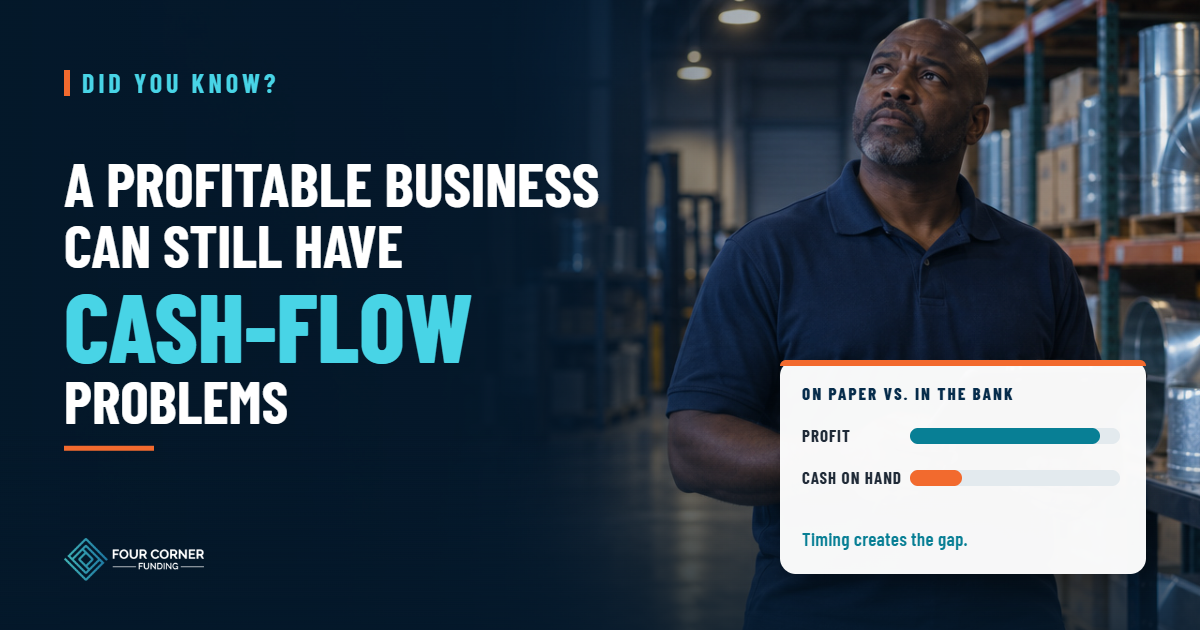
Did you know a profitable business can still have cash-flow problems? Profit is an accounting result. Cash flow is about timing: when money actually arrives and when it has to go out. A business can be healthy on paper and still run short of cash at exactly the wrong moment.
Understanding that gap is one of the most practical things an owner can do, whether or not financing is ever part of the answer.
Four Numbers That Are Easy to Confuse
Profit tells you whether the business model works over a period. Available cash tells you whether you can pay this week’s bills. Owners need both answers.
Where Profitable Businesses Run Short
The gap between profit and cash usually comes from timing. Common causes include:
- Customers paying on terms. The sale counts when it is invoiced, but the cash may arrive 30, 60, or 90 days later.
- Inventory and materials bought up front. Cash goes out before the goods are sold or the job is billed.
- Growth. A bigger contract can mean more payroll and materials long before the larger payment comes in.
- Loan principal payments. They use cash every month, even though they do not appear as an expense on the profit and loss statement.
- Taxes and seasonal swings. Large payments and slow months do not always line up with the strong ones.
- Large purchases paid in cash. Buying equipment outright can drain reserves needed for operations.
How the gap forms
Week 1 — The job is finished and invoiced on 45-day terms. On paper, the revenue is in.
Weeks 2 to 6 — Payroll, rent, materials for the next job, and a loan payment all go out.
Week 7 — The customer pays. The business was profitable the whole time, but the cash arrived after the bills did.
Profitability does not always mean cash is available when the business needs it.
Why This Shows Up in a Funding Review
A profit and loss statement shows results over a period. Bank statements show what actually happened day to day: deposits, balances, low points, and the payments going out. That is why many funding sources look at banking activity alongside financial statements, as we explained in what your bank statements can tell an underwriter.
A business with healthy profits but repeated low balances or overdrafts may raise questions that the profit figure alone does not answer.
When Working Capital May Help, and When It May Not
Financing can help bridge a timing gap when the underlying business is sound and repayment lines up with cash that is genuinely coming in. Depending on the situation, owners may look at working capital, a business line of credit, or receivables financing for invoices waiting to be paid. We compared those structures in choosing the right type of business funding.
Borrowing is not always the answer. Financing does not fix pricing, margins, or spending problems, and new payments reduce future cash flow. If the business already carries several obligations, adding another can make the squeeze worse, as we covered in how existing debt affects future capital. Eligibility and terms vary, and not every business qualifies.
Practical Steps Before Cash Gets Tight
- Keep a simple rolling cash forecast that shows the weeks ahead, not just the month behind.
- Invoice promptly and follow up on overdue accounts consistently.
- Review payment terms with customers and suppliers so they work for both sides.
- Set aside money for taxes and known large payments as revenue comes in.
- Build a cash reserve during stronger months.
- Look at capital options before the need is urgent, not during the crunch.
Where Four Corner Funding Fits
Four Corner Funding helps business owners look at revenue, banking, existing obligations, and the purpose of the funds together. If a timing gap is the issue and the business may be ready, you can apply for funding and explore options through independent third-party funding sources. If you want to see where you stand first, start with Pre-Qualification. Both can begin without a credit check.
Funding if you’re ready. A path forward if you’re not.
Close the Gap Between Profit and Cash.
Explore working capital options built around how your business actually gets paid.
Profit keeps a business alive over time. Cash keeps it running this week. The strongest owners watch both, and plan for the gap before it arrives.
Disclaimer: This article is for general educational purposes only and is not accounting, legal, tax, or financial advice. Four Corner Funding is not a lender and does not make credit decisions. Financing is provided by independent third-party funding sources and is subject to their underwriting, eligibility requirements, product availability, and documentation requirements, all of which vary. The timeline above is illustrative. Borrowing may not be appropriate for every business or situation. Pre-Qualification and readiness results are not loan approvals or final credit decisions, and approval is not guaranteed.