Most funding conversations begin with one question: can I get approved? A better first question is often: approved for what?
Did you know you may be applying for the wrong type of business funding? Business financing is not one product. Different structures exist because businesses need money for very different jobs, and a structure that fits one job can be a poor fit for another.
A mismatch can lead to a decline. It can also lead to an approval that creates a new problem: payments that arrive before the investment pays off, or a short-term solution carrying a long-term need.
Start With the Job the Money Needs to Do
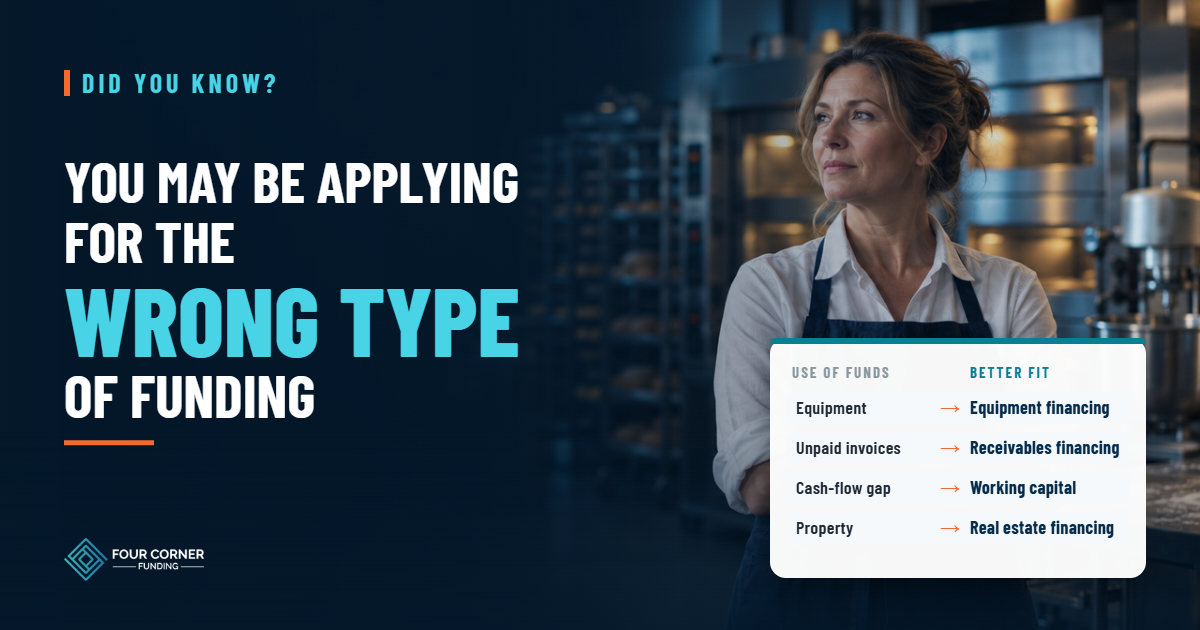
The use of funds is one of the clearest signals of which structures may fit. The table below is a general starting point, not a recommendation. Availability and eligibility vary by business, product, and funding source.
The question is not simply, “Can I get funding?” It is, “What type of capital fits this transaction?”
What a Mismatch Looks Like
Mismatches are common, and they are rarely obvious at the moment of applying. Three patterns come up often.
Short-term money for a long-term asset
A business uses fast, short-term financing to buy equipment it will use for years. Payments come due long before the equipment has paid for itself, and cash flow gets squeezed. Equipment financing is generally structured around the asset itself.
A long process for an urgent need
Some financing, including many SBA and real estate transactions, can involve substantial documentation and longer timelines. If the need is immediate, the process may not fit, even when the business could qualify. Timelines vary by transaction and funding source.
Revolving credit for a permanent need
Lines of credit and cards are designed to be drawn and repaid. Using them to fund something permanent can leave balances high and available credit low for a long time, which can affect how the profile looks. We covered that in how credit card utilization can affect more than your score.
Four Questions That Point Toward the Right Structure
1. What exactly is the money for?
“Growth” is not a use of funds. A truck, three months of payroll, or a down payment on a building is.
2. How long will it take to pay for itself?
The repayment period should make sense next to how long the money takes to produce a return.
3. Is there an asset, invoice, or property involved?
When the need is tied to something specific, financing can sometimes be structured around it.
4. How fast do you need it, and what can you document?
Speed and documentation requirements differ widely between products. Both narrow the field.
One Business, Several Needs
Real situations rarely involve just one need. Consider a commercial contractor that wins a large job. To deliver it, the business needs a new work truck, materials up front, and payroll for a crew while it waits for the customer to pay on net-60 terms.
Treating that as a single “funding request” can push all three needs into one structure that fits none of them well. Broken apart, the picture changes: the truck is an equipment question, the unpaid invoices may be a receivables question, and the gap before payment may be a working capital question. Whether any of those options is available depends on the business and the funding source, but separating the needs makes it far easier to see what could fit.
The same exercise works for any business. List each thing the money is meant to do, then ask which structure was designed for that job.
The Business Has to Fit the Product, Too
Choosing a structure that fits the purpose is half the match. The other half is whether the business fits that product’s underwriting. Different products place more weight on different parts of the file, as we explained in what lenders may look at beyond your credit score.
A product that fits the purpose but not the profile may still not work. The goal is a structure that fits both: the job the money needs to do, and the business that will repay it.
That is also why sending the same request to every available product rarely helps. A clear purpose and an honest view of the profile usually narrow the options to the few worth pursuing.
Where Four Corner Funding Fits
Four Corner Funding helps business owners look at the purpose, the amount, and the business profile together. Depending on eligibility, that can include exploring working capital, lines of credit, term, revenue-based, equipment, receivables, SBA, acquisition, and commercial real estate financing through independent third-party funding sources. Not every business qualifies for every product.
If you know what you need and are ready to move, you can apply for funding. If you would rather see where you stand first, start with Pre-Qualification. Both can begin without a credit check.
Funding if you’re ready. A path forward if you’re not.
Start With the Right Kind of Capital.
Tell us what the money is for, and explore the financing structures that may fit.
The right funding is not just the funding you can get. It is the funding that fits the job, fits the business, and still makes sense when the payments begin.
Disclaimer: This article is for general educational purposes only and is not credit, legal, tax, or financial advice. Four Corner Funding is not a lender and does not make credit decisions. Financing is provided by independent third-party funding sources and is subject to their underwriting, eligibility requirements, product availability, and documentation requirements, all of which vary. The financing examples above are general and are not recommendations or lender criteria. SBA financing is offered through participating lenders and is subject to SBA program requirements. Pre-Qualification and readiness results are not loan approvals or final credit decisions, and approval is not guaranteed.